
Did you blink? Did you see it? The market crashed! Yes, but it's making all-time highs now. Well that's confusing. Which is it? Is everything good or is everything bad? The answer is, as always, a bit complicated, but mostly neither. It just is. Let me explain.
The market has been moving so fast that after I wrote my initial piece that was meant to pull people back from the ledge, I had to trash it because by the end of the week, the S&P 500 was making new all-time highs. The conflict in the Middle East is all the news can talk about.
What has it amounted to for your investments? I took a worried call from one of my clients (notice I didn't say panic, we're not there yet, friends) a few weeks ago when it was clear that this conflict with Iran wouldn't go away overnight. He said to me, "Alright. I haven't looked at my account because I'm afraid to, but now I just need to know. Did I lose everything I just put in?" I could almost hear the pit that was sitting in his stomach. He had made a sizable investment at the worst time possible, in the middle of January when nobody could even point to the Strait of Hormuz on a map.
I said to him, "I hope you're sitting down." And then I let the silence hang there as if unsure how to say my next thought. Honestly, I felt a little bad for building it up. "You're down 0.7% year to date." He laughed out of shock and relief and forgave me for the theatrics. We've been through a lot together, so I was just treating him like a friend who needed someone to give him a good dose of truth. This just wasn't something he needed to worry about for his investments.
Why shouldn't he worry about it? Well, like you, he's diversified and taking on the correct level of risk for his goals. Like yours, his account is being rebalanced when an opportunity to buy cheaper stocks comes around.
As it pertains to your finances, there is something that I think about regarding this current conflict in the Middle East. Inflation. And we don't even have it that bad. We are indirectly suffering from high oil prices because most of our oil doesn't travel through there. You would really be feeling the pain if you lived in Southeast Asia. Fuel prices in some countries have jumped 50% or more since the beginning of the year, and in some cases diesel has nearly doubled. It continues to fluctuate wildly. For us, this likely means that the cost of goods will rise.
So what do we do about it? I'm using the royal we here, but basically nothing. At least nothing different from what we're already doing. We (the plebeian collective version now) need to own assets that rise in value over time. Ideally faster than inflation rises. Naturally, we should ask the question: how often does that happen? Answer: It depends (I hope you're seeing a pattern here…)
It depends on how long you're willing to sit at the table with me.
I went back and looked at every year since 1920. Not just stock prices: total returns, meaning dividends reinvested, the whole picture. And I compared that against inflation over the same period. The question was simple: how often does the stock market actually outpace inflation?
Take a look at this chart. The blue line is the S&P 500, the red line is inflation, and those red shaded areas are the moments when inflation was winning. Watch what happens as you move from the one-year chart to the ten-year chart. The red almost disappears.
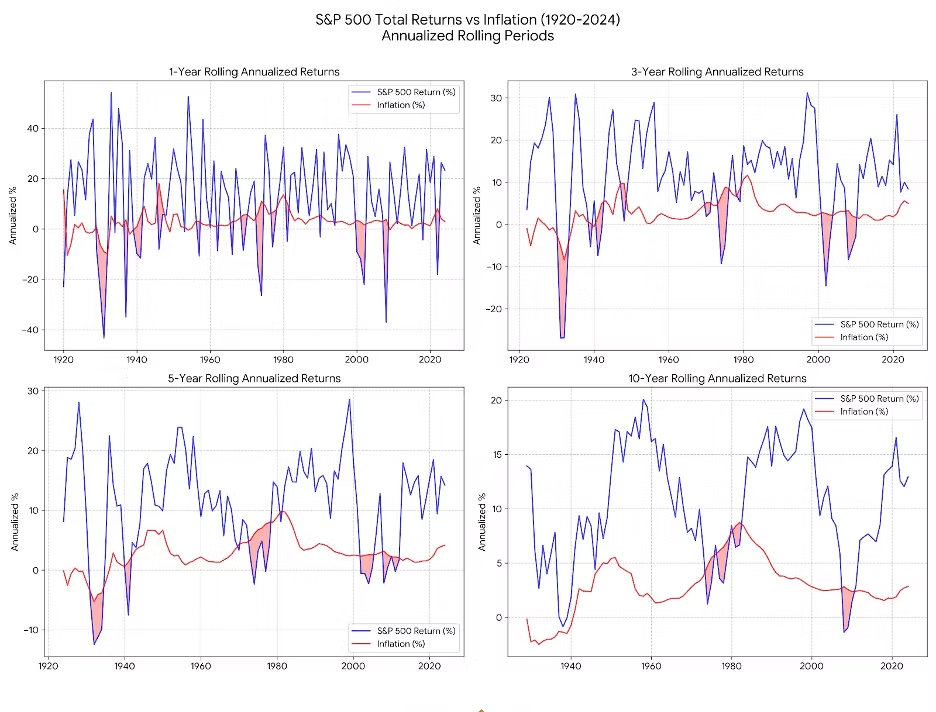
Over any single year, the stock market wins about 70% of the time. Pretty good, but not exactly a sure thing. One out of every three years, inflation wins. If you're checking your account every day, that's going to feel terrible roughly a third of the time.
Now here's the number I want you to sit with. Over any rolling ten-year period since 1920, the stock market has beaten inflation almost 90% of the time. And the decades where it didn't? They were the three worst economic stretches in modern American history. The Great Depression. Peak stagflation. And the unlucky decade that started at the top of the dot-com bubble and ended at the bottom of the financial crisis.
Think of it like poker. In any given hand, a bad card can beat you. Over a whole night of playing, the better hand usually wins. Over a season of Friday night games? The odds take over. Time is what turns the market from a gamble into a system.

I went a little further and tortured the data some more. "Tell me what you know!" I said lovingly. And boy did it talk. Those numbers are for a portfolio that's 100% stocks. That's not what you own. You own a mix: stocks and bonds working together. So I ran the same analysis on three different portfolios: all stocks, all bonds, and a diversified mix of both. I used a portfolio with 60% stocks and 40% bonds as the representative for a diversified portfolio.
Here is the summary comparing the three scenarios based on the historical data from 1920 to 2024. The percentages represent the amount of time that inflation grew faster than the respective asset or portfolio over the given rolling timeframe.
| Rolling Period | 100% S&P 500 | 100% Fixed Income (Bonds) | 60/40 Portfolio |
|---|---|---|---|
| 1-Year | 29.5% | 35.2% | 24.8% |
| 3-Year | 18.4% | 27.2% | 20.4% |
| 5-Year | 21.8% | 31.7% | 12.9% |
| 10-Year | 10.4% | 32.3% | 9.4% |
| 20-Year | 0.0% | 30.2% | 0.0% |
Share of rolling periods (1920–2024) in which inflation outpaced each portfolio. Lower is better.
The results surprised me a little. You'd think all stocks would win, right? More risk, more reward. But over a ten-year period, the diversified portfolio beat inflation over 90% of the time, slightly better than stocks alone. The blend smooths out the crashes that occasionally drag a pure stock portfolio underwater for years at a time, while still carrying enough growth to stay ahead of rising prices. It's not the fastest horse in any given race, but it wins the most races.
Now look at bonds by themselves. Over ten years, a portfolio of nothing but bonds lost to inflation a third of the time. And here's the part that should bother you: that number barely changes whether you hold them for five years or twenty. Time doesn't save you. Bonds pay a fixed rate. When inflation rises, that fixed payment buys less and less, and there's no mechanism to catch up. It's like being on a treadmill that slowly speeds up while you're stuck in the same gear.
Over twenty years? Both the stock portfolio and the diversified mix have beaten inflation 100% of the time. Every single twenty-year stretch since 1920. Bonds? Still losing about 30% of the time. Talk about a way to lose money safely.
So does it matter that the market is good right now or bad right now? You'll always hear someone shout "This time is different!" This time wasn't different and neither was last time. Your plan was never built for this week. It was built for the next decade. And the decade after that.
Lock Your Doors
Now let me switch gears and talk about something less fun but just as important as your investment strategy: keeping your stuff safe.
Last month I showed you the exciting side of AI when I introduced you to Hermes. But there's another side to this technology that we need to talk about. AI is advancing so fast that software companies are struggling to keep their security up to pace. The same tools that let me build a family assistant in my laundry room are also making it easier for bad actors to find and exploit vulnerabilities in the software you use every day.
Start with the basics. When your phone or computer tells you there's a software update available, don't hit "remind me later" for the fourteenth time. Those updates frequently contain security patches that fix holes someone has already figured out how to exploit. Think of it like this: leaving your software out of date is like leaving your front door unlocked because the new lock is sitting on the counter and you just haven't gotten around to installing it.
While we're on the subject, let me remind you of the single most important rule when someone calls you. If they ask for sensitive information, no matter how knowledgeable they seem about your situation, do not give it to them unless you are 100% certain who they are. If you have even a sliver of doubt, hang up and call back at a number you already have on file. Ask for an extension so you can reach that specific person again.
Scammers have gotten remarkably sophisticated. They'll time their calls right after you've opened a new account or made a change to a service. They'll say something like, "We noticed you just made this update, we need to confirm a few details to finish processing it. Can you verify your Social Security number?" It sounds reasonable in the moment. That's the point. This isn't theoretical. It actually happened to a client recently.
This applies to us too. Kimberly and I will never ask you for your Social Security number over the phone. We already have it. We will never ask for passwords, your mother's maiden name, or any security questions. We act as gatekeepers for your financial life, which makes us a very tempting target for someone to impersonate. If you ever get a call from someone claiming to be us and something feels off, please say "Let me call you back." We will take zero offense. In fact, we'll be proud of you. Then dial the number you know is ours.
Guides
Here's another way to protect and care for yourself and for your family. If you've built a financial plan with me, you already have one central place to see the full picture. You can access your private plan through the planning portal. This is also valuable for someone who may need to step into your shoes when you're gone. But your financial plan likely doesn't cover everything. The paintings from Grandma that have no market value but huge sentimental value. The online photo storage service full of family moments. There are just many things that don't generally make it into your financial plan that would be important for your loved ones to know about.
I've made a few guides that help you to capture these assets. One is for your digital life and the other is for your more tangible assets. The third guide is to help anyone who has lost a loved one. If it's a client, I drop what I'm doing and help the surviving family create a game plan for how to handle things. But more often than not, I hear about a friend or family member who has passed. In those instances, I have always wanted to offer more than my condolences but didn't really know how. Well, this guide is how I get to do that now. Feel free to share any of these documents. It would only bring me joy to know that my work is helping more people.
- Asset & Liability Inventory
- Digital Asset Locator
- What To Do When A Loved One Passes Away
That's it for this month. As always, if anything here sparked a question or you just want to talk through how this all connects to your situation, you know where to find us. We're here.